
Nobody wants a range, so here is one
A kitchen in the GTA runs somewhere between forty thousand and a quarter of a million dollars.
That range is useless to you, and it is also honest, which is the problem with the question. So here is the more useful version. In the houses we work in around Markham, Vaughan and Richmond Hill, a full kitchen where the cabinets are replaced, the layout stays roughly where it is, and the finishes are good but not rare, lands between eighty and a hundred and forty thousand.
Move a wall and it goes up. Move the plumbing stack and it goes up a lot. Keep the existing layout and buy stock cabinets and you can be under sixty.
What follows is where that money actually goes, so you can read your own quote.
Cabinets are half the job
In almost every kitchen we price, cabinetry and countertops are between forty and fifty-five percent of the total. Everything else, all the trades and the tile and the paint and the lighting, shares the rest.
That is why a kitchen quote is really a cabinet decision with a room attached.
Stock cabinets come in fixed widths, usually three inch increments. They are the cheapest and they are fine, as long as your room happens to suit those widths. Where it does not, you get filler panels, and a run of fillers is what makes a new kitchen look like it came out of a box.
Semi-custom gives you the same factory boxes with more sizes, more doors and more finishes. This is where most good kitchens land.
Custom means the boxes are built for your room. Nothing is a filler, the run terminates properly, the island is the size the walkway allows rather than the size the catalogue offers, and the panels wrap the appliances. It costs roughly double semi-custom, and in an old or irregular house it is often the only way the room works.
We build our own millwork, so I will declare the interest: I think custom is worth it in a house with walls that are not square. In a 2015 subdivision build with square rooms and standard ceilings, semi-custom does nearly everything custom does for a lot less.
Countertops, priced by the slab and not the foot
Quartz is the default and there is nothing wrong with it. Porcelain is harder and more heat tolerant. Marble is beautiful and it will etch, which we will tell you before you buy it rather than after.
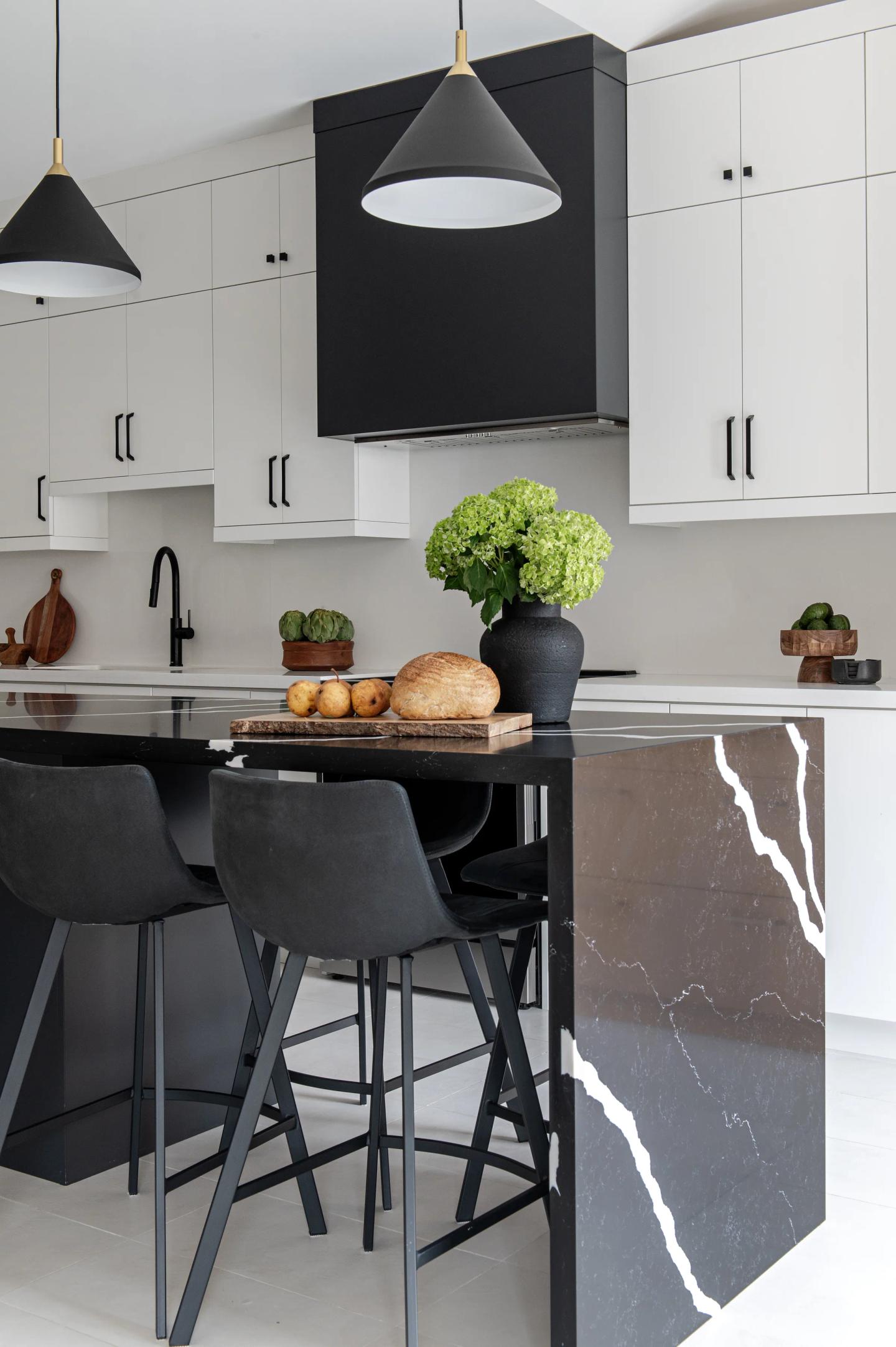
The number that surprises people is not the price per square foot. It is that a waterfall island end can add a whole second slab, that a mitred edge costs more than a straight one because it is more labour and more risk, and that book-matching a backsplash to the counter means buying the slabs together and paying for both.
The five things that actually move the number
Are you moving plumbing? Moving a sink a metre along the same wall is minor. Moving it to an island, or to the other side of the room, means opening the floor. In a bungalow on a crawl space that is a morning. In a two storey on a finished basement below, it means the basement ceiling comes down.
Are you moving walls? Removing a wall is cheap if it is a partition and expensive if it holds the house up. A structural opening means an engineer, a beam, temporary support and a permit. Budget in the ten to twenty thousand range for the beam alone in most GTA houses, more if the span is long or the beam has to be flush with the ceiling.
Is the electrical panel adequate? A lot of houses around here still run a sixty or a hundred amp service. A modern kitchen with an induction range, a wall oven and proper lighting can push a hundred amp service past comfortable. A service upgrade is its own project.
Is there anything behind the walls you do not know about? Knob and tube, galvanised supply, no insulation, a duct running exactly where the new hood has to go. In houses built before about 1970 we price a contingency for this, because we are not guessing at what is in there, we are guessing at what we will find.
How rare are the finishes? Standard tile from a local supplier arrives in a week. A specific slab from a specific quarry, or a hood in a finish that ships from Europe, can add months and thousands. Rare is expensive twice: once at the invoice and again on the schedule.
What a quote should tell you
If a quote is one page and one number, you cannot compare it to anything, and you cannot tell what happens when something changes.
It should separate the cabinetry from the counters from the appliances from the trades. It should say what the allowances are, in dollars, for the things you have not chosen yet. It should say who supplies the appliances, because a kitchen quote that quietly excludes them is thirty thousand dollars lighter than one that does not.
Two quotes for the same room that are forty thousand apart are usually not two different prices. They are two different scopes, and one of them has left something out.
Where people regret spending, and where they do not
Nobody has ever told us they regret the drawers. Deep drawers instead of lower cabinets with a door and a shelf, full extension, soft close. It is a small line on the quote and it is the thing you touch forty times a day.
Nobody regrets the lighting either, done properly. Not more pot lights. Task light on the work surface, something warm over the island, and a switch layout that means you are not lighting the whole room to make tea.
What people do regret is the appliance package bought on impulse, the pot filler nobody uses, and the second dishwasher in a house of two. Buy the room first. The gadgets are always available later.
How long
A kitchen where nothing structural moves is six to ten weeks on site, after drawings and permits and after the cabinets are built. Cabinet lead time is the part people forget and it usually runs eight to twelve weeks on its own.
Move a wall, add a permit, and you are into four to six months from first drawing to a working kitchen. Any builder who tells you six weeks from the first phone call is quoting the site work and leaving out everything that has to happen first.